Something unusual happens when a single wedding photograph circulates widely enough among the people who plan and design weddings professionally. It stops being a record of one couple’s day and starts functioning as a shared reference point — a shorthand for an aesthetic direction that everyone in the room already knows without having to describe it. That’s what happened after WedLuxe published its January 2026 feature on a pavilion wedding at the Aga Khan Museum designed by Ethereal Creators, and it’s been shaping conversations between Toronto couples and their florists ever since.
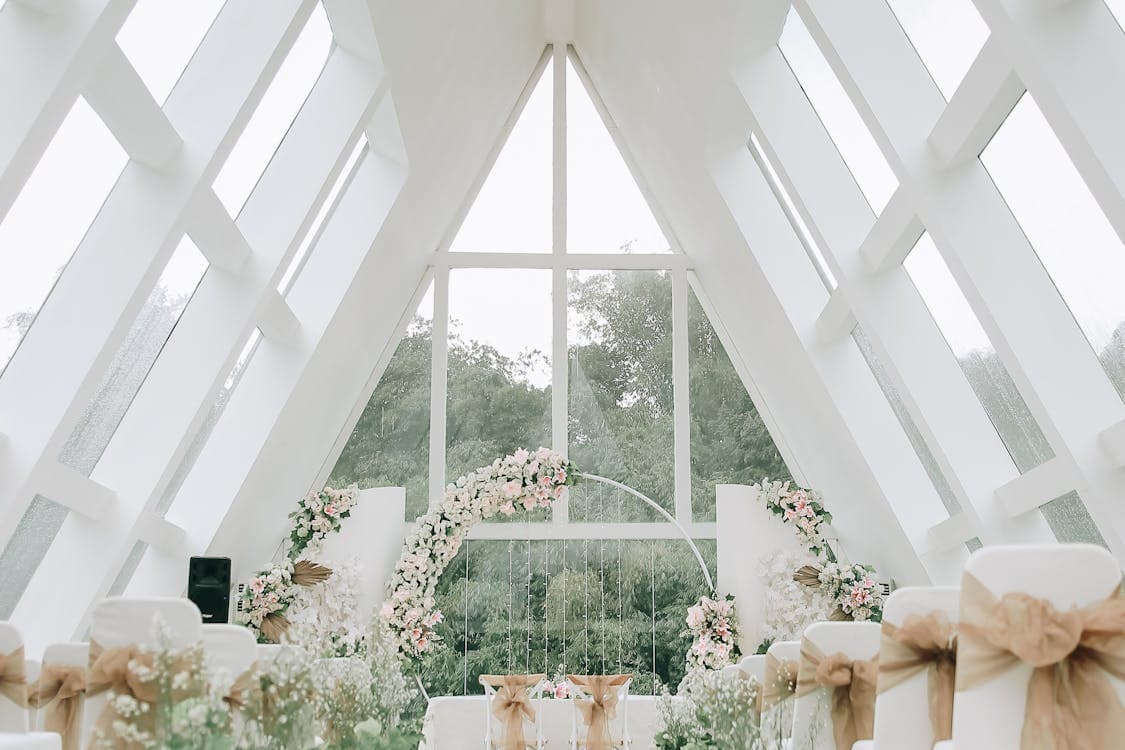
The feature was specific: long gallery tables styled with layered white florals, ribbed glass candleholders, and crystal chandeliers softened with delicate greenery, the whole thing held inside the museum’s glass pavilion with the Don Valley visible beyond the walls. The design’s defining quality was restraint applied at scale — a large, formally set room that felt considered rather than maximalist, with the architecture doing as much visual work as the florals. Ethereal Creators, the North York-based studio behind it, was already well-followed in Toronto wedding circles, but the pavilion feature gave the work a specific image that people could point to.
Why This Particular Venue, This Particular Design
The Aga Khan Museum is a distinct architectural setting — the white granite exterior, the reflecting pools, the geometric precision of the interior — and the floral design Ethereal Creators built for it was explicitly responding to those conditions. White-on-white florals with architectural restraint work at the Aga Khan because the venue’s geometry rewards them. The building has strong lines and a palette of its own; florals that fight it lose. Florals that echo it compound it.
What makes a reference point like this useful is that it travels. The aesthetic logic of the pavilion design doesn’t only work in a glass museum. It’s been showing up in consultations for outdoor tent weddings in the GTA suburbs, for hotel ballroom receptions in North York, and for intimate loft ceremonies that have nothing in common with the Aga Khan’s geometry except the couple’s desire to reference what they saw in the photograph. The underlying principles — restraint over abundance, texture over volume, architectural response over decoration — apply across settings.
How Reference Points Actually Spread in Toronto’s Wedding Market
This is how floral aesthetics actually move through a city like Toronto. Not through trend reports, but through a specific, dateable, locally-produced piece of work that people actually saw in a publication they read. The WedLuxe pavilion feature didn’t describe a trend — it showed one, in real photographs, with real vendor credits, from a real Toronto event. Every engaged couple who read it in January and had a wedding scheduled for 2026 went into their floral consultation with that image somewhere in their mental catalogue.
Florists across the city describe a consistent pattern: clients showing up with the pavilion photographs as a reference, sometimes consciously and sometimes as one of several images in a folder, with an underlying preference for the same qualities — the white palette, the low-drama centerpieces, the emphasis on floral texture over floral volume. What’s striking is how many couples arrive with variations on this direction who are planning weddings at venues that look nothing like the Aga Khan. The aesthetic jumped its architectural origin. It’s being asked for at Guild Inn Estate, at Graydon Hall Manor, at smaller North York event spaces.
What It Means for the Consultation Conversation
The practical consequence is that a reference frame now exists in Toronto’s wedding market that didn’t exist this clearly a year ago. Florists know what couples mean when they invoke the pavilion look, even if the couple doesn’t use those words. The white-on-white layered-texture direction that Ethereal Creators executed so visibly at the Aga Khan has given a name — or at least an image — to something couples were gesturing at but struggling to articulate. That’s genuinely useful for the design conversation, because articulation is most of what makes a floral consultation productive.
It’s also worth noting what the pavilion look isn’t. It’s not a garden-style arrangement. It’s not a maximalist English-country approach. It’s not the bright mixed-colour aesthetic that dominated Toronto wedding photography in the post-COVID rebound years of 2022 and 2023. It’s cooler, more architectural, more dependent on restraint than abundance. For couples whose natural aesthetic runs in that direction, the January 2026 WedLuxe feature essentially gave them permission — here’s proof it works, here’s who did it, here’s what it looked like at the end of the night.
There’s also a vendor-ecosystem dimension to this that doesn’t get discussed enough. When a single studio’s work becomes a dominant reference point in a city’s wedding market, it creates a filtering mechanism for clients. Couples who know they want something in the pavilion direction have a shorthand for communicating it. They can show a photograph. That specificity reduces the ambiguity that makes floral consultations frustrating for both parties, and the florist who can speak to that aesthetic fluently has a meaningful advantage in a market where first consultations increasingly determine whether a booking happens at all. It also raises the bar for every designer in the city — a visible, well-published benchmark pulls the general level of the conversation upward, which is good for the market even for studios whose work runs in a completely different direction.